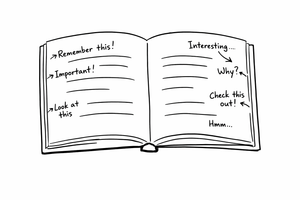
I used to own a home library in South Africa.
Dog-eared. Food-stained. Marked up like a battlefield.
Then we moved to Australia and our entire life got poured into a 20ft container.
Not a metaphor. An actual shipping container. A hard limit: 1,170 cubic feet.
We shed two-thirds of everything we owned. The library didn't make the cut.
Two decades of accumulation. Second-hand bookshops. Hospice charity shelves. Titles that felt like private discoveries, those that never became bestsellers, but mine.
My collection was unsellable.
I owned the original Prince Valiant book series, passed down to me in childhood. I'd graffitied on them as a kid. My first "highlights" were coloring in the artwork.
Nobody pays for your underlines. Nobody bids on your marginal notes. People want pristine.
So I donated everything.
And felt something unexpected:
Not loss of stuff.
Loss of history.
Because the most valuable part of a book isn't the book.
It's the part where you talked back.
Books are one-sided conversations (until you answer)
David Senra has a phrase that snapped this into focus: biographies are a one-sided conversation.[1]
That phrase looks small. But it explains what I lost when I lost my marked-up books:
Not paper.
My side of the conversation.
My underlines were my "yes."
My question marks were my "prove it."
My margin notes were my "this connects."
When those vanish, you don't just forget what the author said.
You forget what you heard.
I lost a younger version of my judgment.
The value in someone else's margins
I no longer buy physical books. I love them, how they feel, how they smell. Nothing is more revealing than opening a page into the thoughts of a reader who has marked it up. Especially a younger version of myself.
I once found a copy of Grit: The Power of Passion and Perseverance by Angela Duckworth left on a bench. It had been marked up by someone who was an expert in the field. They knew the players, personal details, the ideas, everything.
I found more insight from the conversation of the unknown reader, where they disagreed, why they disagreed, than I did from the book itself.
What AI makes urgent
If you don't capture your side of the conversation, you're just bingeing inspiration.
This matters more now. AI can summarize any book in seconds. It can extract key points, generate study guides, answer questions about the content.
But it can't capture what you thought when you read it. It can't preserve your "prove it" moments. It can't remember which ideas made you pause and rethink everything.
Most knowledge workers are collectors pretending to be extractors. Collectors accumulate. Extractors ask: "What decision does this change? What can I test this week? What old assumption does this kill?"
The difference shows up years later: collectors have archives; extractors have judgment.
Inspiration without extraction is expensive.
It costs time. It costs attention. It costs hope.
And leaves you with nothing you can use.
Holiday's rule is brutal (and correct)
Ryan Holiday says reading is work.[2] Page by page. No shortcuts.
He's right.
If you're not marking a book up, if you're not answering back, you're not reading.
Because the point isn't consumption.
It's engagement.
My old library mattered because it was proof.
Those books didn't look impressive. They looked used.
Which is the only compliment that matters.
Then life demanded a different strategy
After the move, I went digital.
Kindle. Audiobooks. PDFs. Readwise. Obsidian.
Not because I stopped loving physical books. Because I was scared of losing my side of the conversation again.
So I did what ambitious people do when fear meets tools:
I tried to build the perfect system.
Evernote became Notion became Obsidian.
And for a while, it worked.
Until I realized I'd rebuilt the same problem in a new costume.
I lost my physical library and lost my voice in the conversation. Now I had a digital library, and I was missing from it again. I'd spent all my time organizing. It felt like progress.
But that's the trap: you shift from building understanding to building infrastructure. From thinking to filing. From extraction to collection.
Nick Milo calls this the collector's fallacy. You think you're learning because you're organizing. But organizing is not understanding. It's just rearranging what you haven't processed yet.
If you spend more time organizing knowledge than using it to think, decide, or extract, you're in productivity theater. The system is not the point. Changed behavior is the point.
Ango's philosophy cuts through the noise
Steph Ango's approach (Obsidian's CEO) helps because it's not "optimal."
It's built for survival over time.[3]
Start with the principle: a vault is just a folder of files.
If you want your thinking to survive, it has to be readable without a company's permission.
Platforms are not archives. The only question that matters: "Can I open this in 2050 with nothing but a text editor?"
If yes, it survives. If no, you're renting safety.
That's not productivity.
That's a worldview.
And it matched the promise I made after donating my library:
Never lose my notes again.
More precisely: I would never again lose my side of the conversation.
The habit worth stealing
Ango's workflow is simple enough to survive real life:
- keep the overhead low
- link aggressively
- leave breadcrumbs for later
He links the first mention of something, often leaving links unresolved.
Empty links are not unfinished work. They're handles. You don't organize in advance. You organize at the moment of need.
You stop organizing to feel safe.
You organize when your life proves it matters.
How the conversation survives
I'm late to the party, but I'm now a Readwise subscriber. I love that it emails me my old highlights.[4]
I get that old-library feeling again. You walk over to the bookshelf, grab a title, flip through the pages.
Not new information.
Old contact.
So I'm building around that: capture, review, revisit.
Capture thoughts as they happen. Review them. Let patterns emerge.
And then the emails: random revisits.
Open an old note. Follow a link. Repair a connection. Let your past self interrupt your current certainty.
Someone will ask if language models can automate this.
They can assist.
But they can't do the one thing that makes learning yours: deciding what you believe.
Understanding builds judgment. Judgment is what you can deploy under pressure.
Don't delegate understanding. That's the whole game.
Not capturing information.
Embracing my side of the conversation.
David Senra repeats this phrase across multiple episodes of Founders: "Reading a biography is a one-sided conversation with someone who can't talk back." The power is in the permanence. Dead founders can't update their position based on your objections. You either extract the pattern or you don't. ↩︎
Ryan Holiday, "Give me 16 minutes and I'll teach you how to read like a PRO" ↩︎
Steph Ango, "File over app" ↩︎
Readwise resurfaces highlights from Kindle, articles, podcasts, and other sources via daily email digests. The spaced repetition approach mirrors the insight from cognitive psychology: memory is not storage, it's reconstruction. Each time you encounter an old highlight in a new context, you're not retrieving. You're rebuilding the connection. ↩︎