
The more people who agree with your decision, the worse it probably is.
This sounds wrong. Agreement feels like progress. Consensus signals maturity. When everyone signs off, you've done your job as a leader.
Except you haven't led at all.
After 21 years building Shopify, Tobi Lütke finally understood why:
Leadership and consensus are two sides of the same spectrum. They don't intersect at all.
I still feel like it is a bit of a secret.
What Most People Hear
A founder defending unilateral decision-making. The standard "move fast and break things" argument dressed up in new language. A rationalization for the control that founders are criticized for keeping.
The Excavation
The Decision Being Made
This isn't Lütke making a decision. This is him recognizing what decision-making really is.
Consensus is always the :absence of leadership. Everyone abdicates responsibility to decide. They prioritize agreement over the best solution.
The Constraint He Discovered
Consensus optimization has a ceiling:
On that spectrum from 1 to 10 it's usually a six or a seven.
This is the trap. Consensus doesn't find the middle. It finds "the best version that everyone can agree on." It's structurally incapable of producing outliers.
While in a presence of leadership, you can hit any number 1 to 10. And if you're a company that wants to hit 8, 9, 10 or die trying, then you kind of have to rule by fiat.
Let me show you what this looks like.
See the pattern? When everyone must agree, you optimize for lack of downsides. Outcomes cluster between 6 and 7.
But keep clicking the arrow. Watch what happens as leadership enters the picture.[1]
The Unspoken Assumption
Why did this take him so long to see?
Even in our language, consensus is a positive term.
When someone says "we reached consensus," it signals progress, alignment, maturity. When someone says "they just decided unilaterally," it signals recklessness, ego, immaturity.
The language hides what's happening. Consensus feels like leadership because there's a group, there's a process, there's agreement. But those are the mechanisms that prevent anyone from leading.
What He Noticed That Others Missed
Lütke does more than avoid consensus. He :weaponizes it.
If I don't want decisions to be made... I create a pricing council.
Watch how this works.
Two layers of protection. First, they won't reach consensus (groups rarely do on pricing). Second, even if they do, he still holds veto power.[2]
This isn't cynicism. It's precision. He doesn't want Shopify "playing too much with pricing all the time." So he creates a structure that guarantees nothing will happen. Then he can say:
Every five years I say okay let's look at pricing from first principles.
:pull A committee isn't a decision-making tool. It's a decision-prevention machine.
The Warning Sign
Why is this still a secret? Because consensus protects you. No one can blame you if everyone agreed. You weren't wrong. You were all wrong. The emotional incentive is obvious: consensus distributes accountability until no one owns it. This is why the entire corporate world is :architected to avoid leadership. Every framework for "good leadership" teaches: get buy-in, build alignment, bring people along. What they're really teaching is how to avoid exposure.
Consensus can be an outcome. But when it's the mechanism for deciding, it guarantees mediocrity.
The Reboot
The spectrum isn't leader-as-dictator versus leader-as-consensus-builder.
It's this: did someone lead, or did everyone agree?
These are mutually exclusive positions. You cannot lead a decision and have consensus around it unless you're "so clever that you can manufacture consensus around what you would have chosen anyways."
Someone decides. Then others execute that decision with their own creativity and leadership in their domains. This is the pattern in every founder-led company that ships outlier products.
I don't believe in top-down decision-making. I believe in pulling decision-making inwards. I create the highest ideal liquidity environments in which we can make very good decisions quickly but where it's very clear who's making decisions and who's consulting on it.
Clarity about who decides is the precondition for speed. Consensus about what to decide is the guarantee of slowness.
Let me show you what this looks like in a meeting.
When leadership is assigned, consultation is valuable. Input flows freely because people know someone will synthesize and decide.
When decision-making is shared, consultation becomes negotiation. Every comment is a bid for influence.
The Implication
When you hear "we need to build consensus," translate it: "We need to avoid leading."
When you see a committee forming to study something, recognize what's happening. Nobody's job.
When pricing is constantly reconsidered, when roadmaps shift based on whoever spoke last, when "strategic priorities" get wordsmithed until everyone agrees, these aren't symptoms of collaboration. They're symptoms of leadership absence.
The brutal implication: most organizations are structurally incapable of producing 8/10 or better outcomes because they've made consensus their decision mechanism.
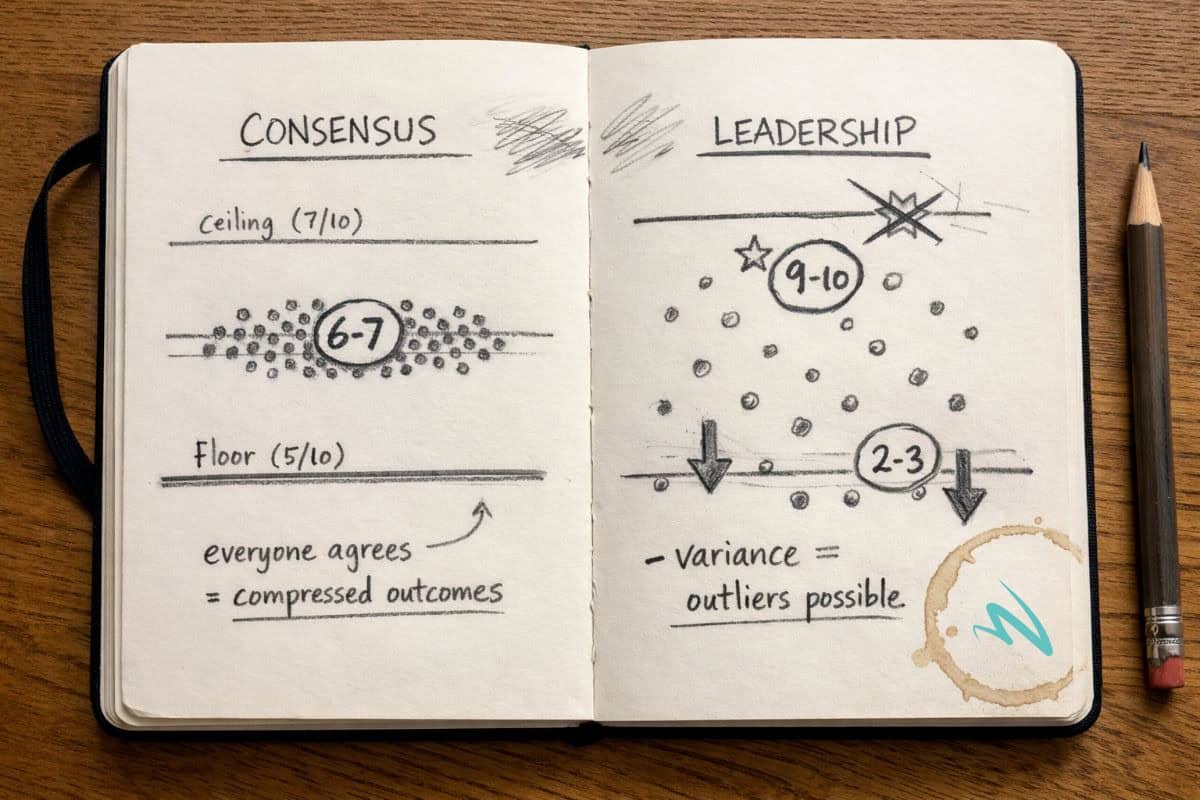
Consensus raises the floor. At least 5 out of 10.
Leadership breaks the ceiling. Potential for 9 or 10, risk of 2 or 3.
:pull If you want outlier results, you need someone willing to own the failures.
But leadership's dark side isn't just wrong decisions. It's structural. The leader who decides alone can become unreachable. Feedback loops break. The team stops saying "this won't work" because they've learned it doesn't matter. Then you get not just 2/10 outcomes, but systematic blindness. Consensus produces mediocrity. Bad leadership produces organizational deafness.
This is why founder-led companies look so different. Not because founders have better ideas. Because they have structural permission to lead decisions instead of building consensus around them.
Use This Tomorrow
Name what you're actually protecting. When you say "let's get everyone aligned," what you often mean is "I don't want to own this alone." Consensus isn't collaboration. It's blame distribution. You should seek input. The question is whether you're requiring agreement because it produces better decisions or because it protects you from responsibility.
Audit where consensus is your decision mechanism. Not "where do we seek input" but "where do we require agreement before acting." Every instance is a ceiling on outcomes.
Weaponize consensus deliberately. When you want to slow something down without saying no, create a committee. When you want to prevent something without forbidding it, require consensus. Use it as architecture, not accident.
Make "who decides" explicit before discussing what to decide. If leadership is assigned, consultation is valuable. If decision-making is shared, consultation becomes negotiation. The quality of the conversation changes based on clarity about who owns the choice.
Source: This excavation draws from ACQ2: How to Live in Everyone Else's Future with Shopify CEO Tobi Lütke. The conversation is dense with buried insights. I'll be returning to it for future excavations.
:x absence
When a group reaches consensus, it means nobody took responsibility for the decision. The group avoided the discomfort of one person owning the outcome.
This is why consensus feels comfortable. No one is exposed. No one can be blamed if it goes wrong.
But that's also why it caps outcomes. No one is empowered to push for 9 or 10, because that requires risking 2 or 3.
:x weaponize
Lütke doesn't just avoid consensus. He uses it as a tool.
When you want to prevent a decision without saying no directly, create a structure that requires consensus. The decision will stall naturally.
This isn't manipulation. It's architectural choice. Sometimes preventing bad decisions is more important than enabling good ones.
:x architected
The phrase "architected to avoid leadership" means the organizational structure prevents anyone from leading.
Examples:
- Every decision requires sign-off from 5 people
- "Collaborative decision-making" is the stated value
- No one has final authority on anything
- Every meeting ends with "let's take this offline"
These aren't bugs. They're features. The organization has chosen consensus as its operating system.
The average stays roughly the same across all four states (around 6.5). But the range explodes. That's the key insight: leadership doesn't improve average outcomes. It increases variance, which means both more failures and more successes. ↩︎
Veto power is the legal authority to stop a decision from taking effect without being able to rewrite it. The word comes from Latin: "I forbid." This is different from consensus, which seeks agreement. Veto simply blocks. ↩︎